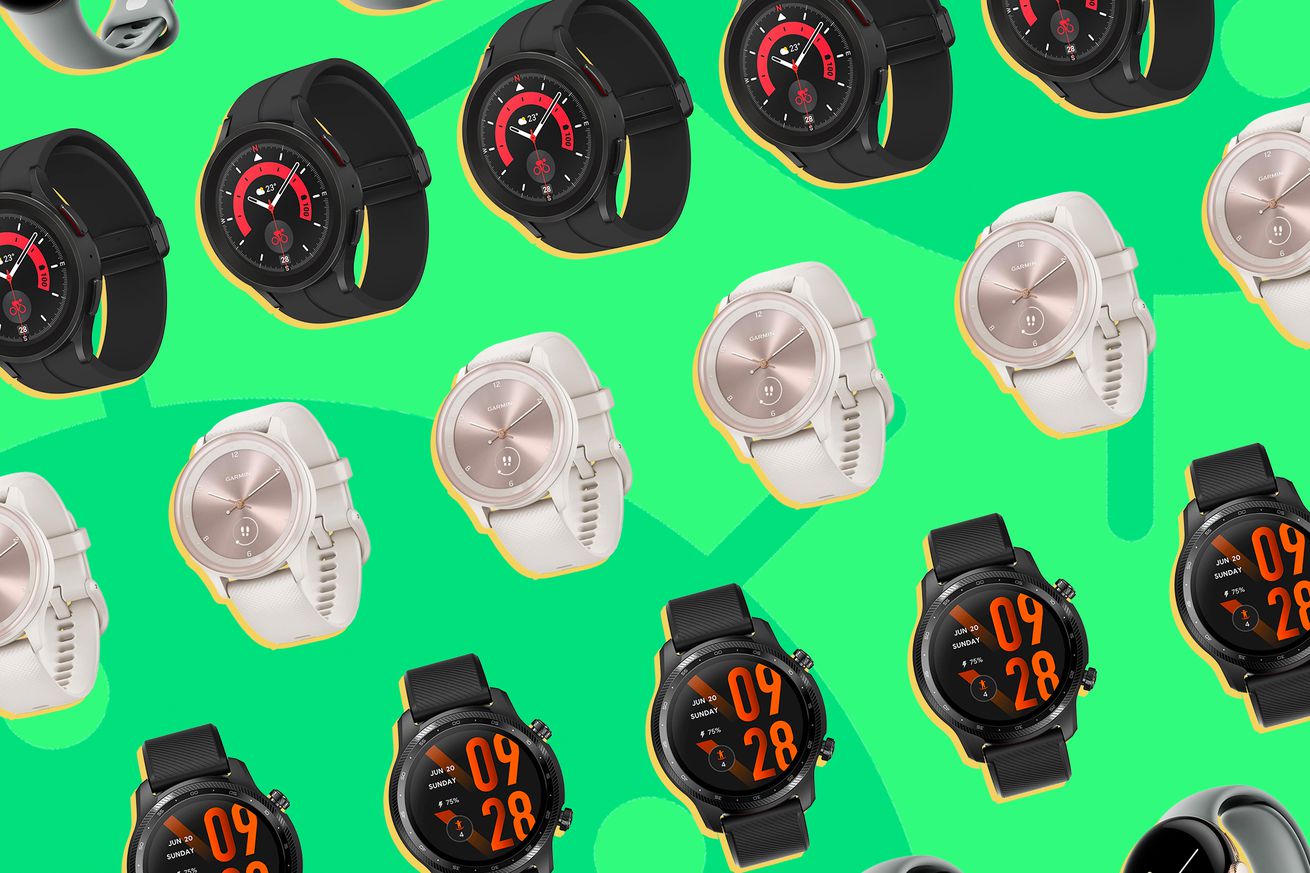
Wear OS is much better than it used to be, so there’s never been a better time to consider a smartwatch.
After a long stretch of slim pickings, the last couple of years have been huge for Android smartwatches. Now there are more good options than ever.
But this is still a transitional era. While we’re encouraged by the stronger third-party app options, the market is still fragmented. Wear OS 4 is already here for Samsung’s Galaxy Watches and both versions of the Pixel Watch, but the larger ecosystem is still catching up to Wear OS 3. And some features, like Google Assistant, are not yet available on certain Wear OS 3 smartwatches — though that one may come via an update sometime in the future.
If you’d rather wait until Wear OS settles down a bit, there are platform-agnostic smartwatches and fitness watches you can buy in the meantime. Otherwise, you’ll want to be aware of the chip and Wear OS version powering your watch. Mobvoi, for instance, only just started rolling out Wear OS 3 to its eligible Wear OS 2 watches. Speaking of Mobvoi, its TicWatch Pro 5 was the first to sport the new Qualcomm Snapdragon W5 Plus in the US, and while it’s a great watch, you may want to wait until there are more W5 Plus watches to choose from. The Pixel Watch 2 has the W5 (no Plus) chip, and the result so far has been zippier performance and better battery life.
So long as you keep the aforementioned caveats in mind, Android users have more smartwatch options than ever before. I’ve rounded up my top picks, but if none of these is the right fit, you can always check out our fitness tracker guide.
Best smartwatch for Samsung phones
Sizes: 43mm, 47mm / Weight: 77g, 85g / Battery life: Up to 30 hours with AOD, 40 without AOD / Display type: Always-on OLED / GPS: Built-in GPS / Connectivity: LTE (optional), Bluetooth, Wi-Fi / Water resistance: Up to 50 meters, IP68 / Music storage: 16GB
If you have a Samsung phone, you’ll get the most mileage out of a Samsung smartwatch. And of the three watches Samsung has in its current lineup, I recommend the Samsung Galaxy Watch 6 Classic.
First off, it’s got a rotating physical bezel — and said bezel is now 15 percent thinner than the Galaxy Watch 4 Classic. The updated design is sleeker than its predecessor, and the larger display is easier on the eyes and is only slightly bigger at 43mm and 47mm. I have small wrists, but the 47mm was still quite comfortable for everyday wear. It’s launching with Wear OS 4, which adds extended battery life, and finally, cloud backups. One UI 5 Watch also adds some minor health and sleep tracking improvements, but this will eventually make its way to older models. While I prefer the Classic, the base Watch 6 model may be the better option if you want a smaller, lighter, sleeker, and cheaper smartwatch.
/cdn.vox-cdn.com/uploads/chorus_asset/file/24816190/236731_Samsung_Galaxy_Watch_6_AKrales_0180.jpg) Photo by Amelia Holowaty Krales / The Verge
Photo by Amelia Holowaty Krales / The Verge
Overall, the Galaxy Watch 6 series is an iterative update, but I appreciate that battery life has improved to the point where I’m no longer anxious whether it’ll last me the entire day. Of course, your mileage will vary depending on your individual use and which settings you enable. For example, turning on continuous SpO2 sensing at night can make the battery drain faster, but using bedtime mode can mitigate that so you only lose 10–15 percent overnight instead of 25–30 percent.
Last year’s $449.99 Galaxy Watch 5 Pro will also get you a great overall experience. It’s not a big upgrade from the Galaxy Watch 4, but the main benefits of the Pro over other models are extra durability, neat GPS features, and battery life. I recommend picking the Pro if you’re a weekend warrior or if multiday battery life is your top priority. We got up to 65 hours in testing, though if you enable the always-on display, you’ll more likely get around 48 to 50 hours. Still, that’s a notable bump over the Galaxy Watch 6 series, the base Watch 5, and the Watch 4 lineup. Software updates (and bigger batteries on newer models) have improved the battery life on these watches, but you’ll still have to charge them daily or every other day. And the Pixel Watch only lasts around 24 hours.
The switch to Wear OS means you’re getting a much more robust third-party app experience than on Tizen-powered Samsung smartwatches, like the Galaxy Watch 3 and the Galaxy Watch Active lineup. You also get more flexibility on services than with any other Wear OS watch. For example, if you want to kick Bixby to the curb in favor of Google Assistant, you can. If you want a more in-depth look at how the Galaxy Watch 5 stacks up compared to the Pixel Watch in particular, you can check out our Versus video. (The majority of the points still apply to the Watch 6, as not a whole lot has changed.)
/cdn.vox-cdn.com/uploads/chorus_asset/file/24000821/226256_SAMSUNG_GALAXY_WATCH_5_PRO_PHO_vsong_0004.jpg) Photo by Victoria Song / The Verge
Photo by Victoria Song / The Verge
Samsung Health also delivers a good overall fitness tracking experience, especially since you can enable turn-by-turn navigation for hiking and cycling activities. Samsung is expanding this to include walks and runs with One UI 5 Watch. We weren’t too impressed with nightly SpO2 readings, but Samsung’s overall sleep tracking continues to improve. You also get built-in GPS, body composition analysis, irregular heart rate notifications, fall detection, emergency SOS features, and EKGs.
We don’t necessarily recommend the Galaxy Watch 6 series or 5 Pro if you don’t have a Samsung phone. EKGs require the Samsung Health Monitor app, which is limited to Samsung phones. Also, while you can customize the buttons to launch your digital assistant of choice, the shortcut for contactless payments is hard coded to Samsung Pay / Wallet — which is also gated to Samsung phones unless you sideload the APK — and requires you to sign up for Samsung’s service. You can work around it, but all Samsung watches work best with other Samsung devices.
Read my full review of the Samsung Galaxy Watch 6 series.
Best Android smartwatch for non-Samsung users
Sizes: 41mm / Weight: 31g / Battery life: Roughly 24 hours with AOD enabled / Display type: Always-on OLED / GPS: Built-in GPS / Connectivity: LTE (optional), Bluetooth, Wi-Fi, Safety Signal with Fitbit Premium / Water resistance: 5ATM / Music storage: 32GB
The $349.99 Google Pixel Watch 2 is a significant improvement over the original. The Galaxy Watch 6 lineup will still get you a more polished overall experience, but the Pixel Watch 2 is the better choice for Android users who aren’t on a Samsung smartphone.
That’s because of ecosystems. Some features of Samsung’s watches only work with Samsung phones. Broadly speaking, the Pixel Watch doesn’t care what Android phone you have; you’ll get the same experience regardless. That said, its call screening feature will only work if you pair it with a Tensor-equipped Pixel phone. It’s a little disappointing, but compared to Samsung, the Pixel Watch 2 doesn’t gatekeep health features based on what phone you have. It’s also always going to have the latest updates to Google services like Google Maps, Google Wallet, YouTube Music, and Google Assistant because, well, it’s Google’s smartwatch. With the Pixel Watch 2, Google also added Calendar and Gmail to its list of supported apps. Speaking of which, buying the Pixel Watch 2 will also get you a six-month trial of Fitbit Premium and a one-month trial of YouTube Music.
/cdn.vox-cdn.com/uploads/chorus_asset/file/24992630/236828_Pixel_Watch_2_AKrales_0830.jpg) Photo by Amelia Holowaty Krales / The Verge
Photo by Amelia Holowaty Krales / The Verge
The most important upgrade from last year is that the battery reliably lasts 24 hours with the always-on display enabled. Some of this is due to the more power-efficient Wear OS 4 and a new Qualcomm Snapdragon W5 processor. (It also means zippier performance overall.) It’s also switched to a pin-charging system, which translates to much faster charging. You can get about 50 percent in 30 minutes, and a full charge takes about 75 minutes. Because of a firmware update, the original Pixel Watch now charges more slowly — so the difference is extra noticeable.
Compared to last year, Google has also done a better job this year of integrating Fitbit’s health and fitness features. The Pixel Watch 2 now has a multipath sensor that enables 40 percent more accurate heart rate tracking for vigorous exercises. Plus, you can utilize heart rate zone and pace training — features other fitness smartwatches have had for a long time. The exercise views are also easier to read. It also now has a skin temperature sensor and the Fitbit Sense 2’s continuous electrodermal activity sensor (cEDA). This means the Pixel Watch 2 is now capable of proactive stress tracking. When signs of physiological stress are detected, you’ll be prompted to reflect on your mood, take a walk, or do a breathing exercise. It’s imperfect, but it’s one of the best implementations of mindfulness features we’ve seen thus far.
/cdn.vox-cdn.com/uploads/chorus_asset/file/24992623/236828_Pixel_Watch_2_AKrales_0623.jpg) Photo by Amelia Holowaty Krales / The Verge
Photo by Amelia Holowaty Krales / The Verge
Google has also introduced new personal safety features. Safety Check is a proactive timer that will send your location to loved ones if you’re in a pickle. You set an activity (i.e., taking public transportation or walking alone) and a timer duration. If you don’t check in when the timer goes off, your location will automatically be shared with your emergency contacts. Another neat feature is Safety Signal. If you get an LTE watch and have a Fitbit Premium subscription, you don’t need an active LTE plan in order to utilize emergency services.
One thing to be mindful of is durability. While the domed display is beautiful, we cracked the screen on the original Pixel Watch and got deep scratches on the Pixel Watch 2. Google doesn’t offer any repair options, but with the Pixel Watch 2, it has started offering its Preferred Care extended warranty, so you have more replacement options should something happen. It’s not ideal since it’s limited to the US and Canada, but it’s a step in the right direction.
Read my full Google Pixel Watch 2 review.
Best smartwatch you can upgrade to Wear OS 3
Sizes: 44mm w/22mm straps / Weight: 51g / Battery life: 24 hours / Display type: OLED touchscreen / GPS: Built-in GPS / Connectivity: Bluetooth, Wi-Fi / Water resistance: 5ATM / Music storage: 8GB
You could argue that by putting out a horde of Wear OS watches year after year, Fossil has singlehandedly kept Wear OS afloat during its darkest days. On the bright side, that commitment to the platform means the $299 Gen 6 is one of the better third-party options — especially since it has Google Assistant on Wear OS 3.
The Fossil Gen 6 launched in 2021 as a Wear OS 2 watch running on a Snapdragon Wear 4100 chip but has since gotten the upgrade to Wear OS 3. You may just have to manually update the software once you buy it. That’s a big reason why you can find it on sale pretty often, usually for around $220–$230. In October 2022, Fossil also began rolling out upgrades to all of its designer-branded smartwatches, like the Skagen Falster Gen 6 and the Michael Kors Gen 6.
/cdn.vox-cdn.com/uploads/chorus_asset/file/22996111/dbohn_211105_4864_0003.jpg) Image: Dieter Bohn / The Verge
Image: Dieter Bohn / The Verge
The Gen 6 watches have Alexa compatibility, contactless payments via Google Wallet, and access to the Google Play store for third-party apps like Strava and Spotify.
In late 2022, the company also recently released its $299 Gen 6 Wellness Edition. As a result, it’s also beefed up available health features across the Gen 6 devices. That includes SpO2 readings, VO2 Max, automatic wo
